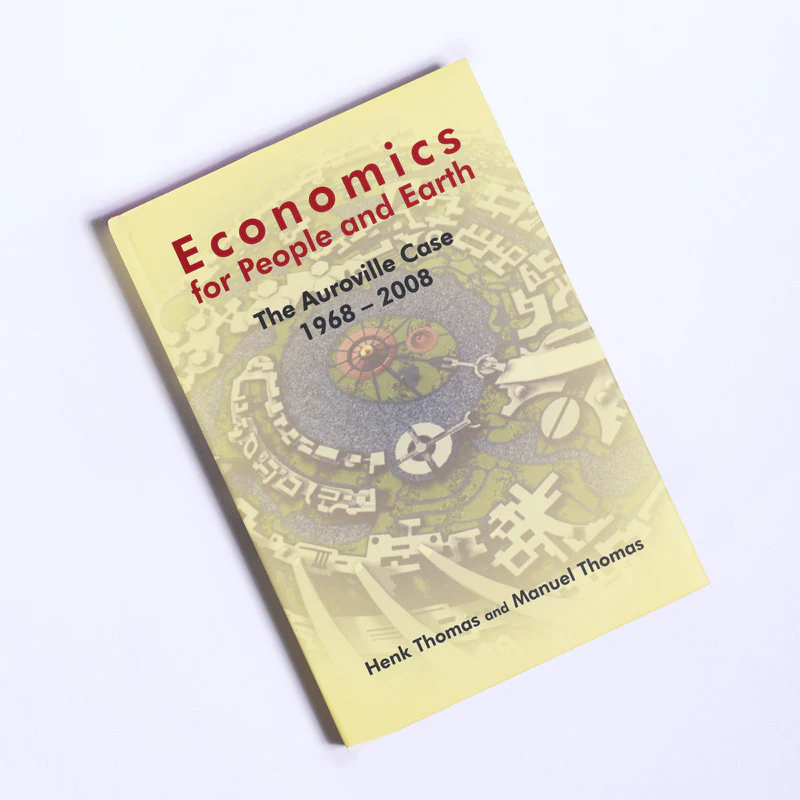
Economics for People and Earth - The Auroville Case 1968-2008
Auroville, an international township in South India, was founded in 1968. A small group of about 200 pioneers on a heavily eroded plateau, close to the Bay of Bengal near Pondicherry, set out to reforest the barren land and create a new socio-economic, ecological and spiritual habitat with a vision to build “a city the Earth needs”. Forty years later, a vibrant community of almost 2,000 people from 43 nations had emerged, providing employment to some 4,000 men and women from nearby villages. Meanwhile, they had reforested thousands of acres of land, built homes, health centres and schools, developed organic farms, experimented with renewable energy and cost-effective building technologies, reached out to the neighbouring villages, and set up a plethora of businesses and services. This book is the result of 15 years of research on Auroville’s economy. It outlines the principles envisaged by its founders, traces its history over the past four decades, investigates the growth of employment opportunities, offers a window on its economic activities through case interviews, and analyses the performance of its commercial and services domains. It also gauges Auroville’s sustainability as a model of durable socio-economic development “for People and Earth”, and as an antidote for the all-pervading impact of global capitalism.
This edition is for sale in India, Bangladesh, Bhutan, Nepal, Pakistan and Sri Lanka. Not for export elsewhere.
Original: $8.32
-65%$8.32
$2.91More Images


Economics for People and Earth - The Auroville Case 1968-2008
Auroville, an international township in South India, was founded in 1968. A small group of about 200 pioneers on a heavily eroded plateau, close to the Bay of Bengal near Pondicherry, set out to reforest the barren land and create a new socio-economic, ecological and spiritual habitat with a vision to build “a city the Earth needs”. Forty years later, a vibrant community of almost 2,000 people from 43 nations had emerged, providing employment to some 4,000 men and women from nearby villages. Meanwhile, they had reforested thousands of acres of land, built homes, health centres and schools, developed organic farms, experimented with renewable energy and cost-effective building technologies, reached out to the neighbouring villages, and set up a plethora of businesses and services. This book is the result of 15 years of research on Auroville’s economy. It outlines the principles envisaged by its founders, traces its history over the past four decades, investigates the growth of employment opportunities, offers a window on its economic activities through case interviews, and analyses the performance of its commercial and services domains. It also gauges Auroville’s sustainability as a model of durable socio-economic development “for People and Earth”, and as an antidote for the all-pervading impact of global capitalism.
This edition is for sale in India, Bangladesh, Bhutan, Nepal, Pakistan and Sri Lanka. Not for export elsewhere.
Product Information
Product Information
Shipping & Returns
Shipping & Returns
Description
Auroville, an international township in South India, was founded in 1968. A small group of about 200 pioneers on a heavily eroded plateau, close to the Bay of Bengal near Pondicherry, set out to reforest the barren land and create a new socio-economic, ecological and spiritual habitat with a vision to build “a city the Earth needs”. Forty years later, a vibrant community of almost 2,000 people from 43 nations had emerged, providing employment to some 4,000 men and women from nearby villages. Meanwhile, they had reforested thousands of acres of land, built homes, health centres and schools, developed organic farms, experimented with renewable energy and cost-effective building technologies, reached out to the neighbouring villages, and set up a plethora of businesses and services. This book is the result of 15 years of research on Auroville’s economy. It outlines the principles envisaged by its founders, traces its history over the past four decades, investigates the growth of employment opportunities, offers a window on its economic activities through case interviews, and analyses the performance of its commercial and services domains. It also gauges Auroville’s sustainability as a model of durable socio-economic development “for People and Earth”, and as an antidote for the all-pervading impact of global capitalism.
This edition is for sale in India, Bangladesh, Bhutan, Nepal, Pakistan and Sri Lanka. Not for export elsewhere.